How We Chose Natural Stone Countertops for Our Kitchen (Well, Almost)
When we started choosing natural stone countertops for our kitchen at Five Trails, I was fairly certain I knew what I wanted. Something beautiful and dramatic, a piece of stone that would feel like art in the middle of the room. I had visions of Patagonia quartzite, with its incredible movement and layers of color, and a large island that would be the centerpiece of the kitchen. So how did we end up falling in love with honed black granite kitchen countertops instead? That’s a story involving a whole lot of stone yards, some beautiful surprises, and a budget that had other ideas.
I still think Patagonia is one of the most beautiful stones I’ve ever seen. But somewhere between the inspiration photos, the stone yards, the cabinet samples and the growing number of decisions that come with building a custom home, something changed.
We fell in love with black countertops.
Not just any black countertops, though. We wanted something that felt old and soulful, with depth and character, the kind of surface that might have been in a European farmhouse for generations. Something beautiful without trying too hard.
And the more we explored, the more we realized that what we thought we wanted and what we actually loved were two very different things.
Starting with the kitchen, not the countertops
One thing I’ve learned through this process is that choosing materials individually is a dangerous game. It’s easy to fall in love with a gorgeous slab of stone in a showroom, but that doesn’t necessarily mean it’s the right stone for your home.
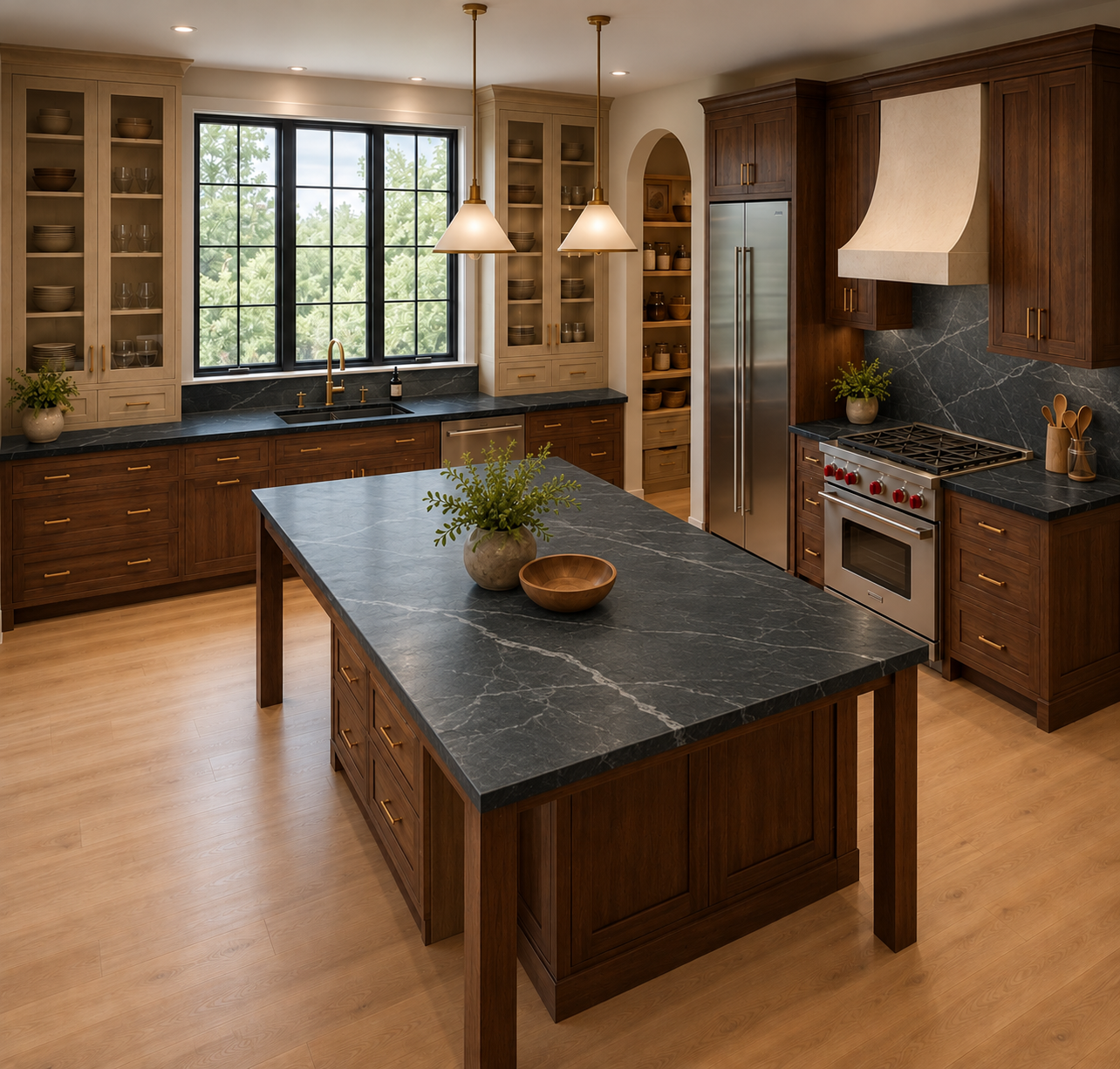
Our kitchen has natural walnut shaker cabinets, a few glass-front cabinets in Accessible Beige, polished nickel hardware and light oak floors. It’s open to our great room, where we’re incorporating old barn beams, a natural stone fireplace and other architectural details that we hope will give a brand-new home some of the character of an older one.
We’ve been calling our style modern heritage, which probably means something slightly different to everyone, but to us it’s a combination of timeless materials, natural textures, traditional influences and just enough unexpected detail to keep things interesting. We want Five Trails to feel like a home that’s been collected and loved over time, not a house where everything was selected from the same catalog in the same year. With that in mind, the countertops needed to do more than look beautiful in a photograph. They needed to work with the walnut, the floors, the stone fireplace and the wood beams, and they needed to feel like something we would still love 20 years from now.
If you’ve ever shopped for natural stone countertops, you know how quickly it can become an obsession. There are thousands of slabs, and even two slabs with the same name can look completely different.
Choosing natural stone kitchen countertops
We considered Taj Mahal quartzite, which is undeniably beautiful and has become incredibly popular, but I kept coming back to the feeling that I wanted something a little less expected. I didn’t want to make decisions based on what’s trending right now, especially in a house we’re building with the intention of staying for a very long time, hopefully forever.
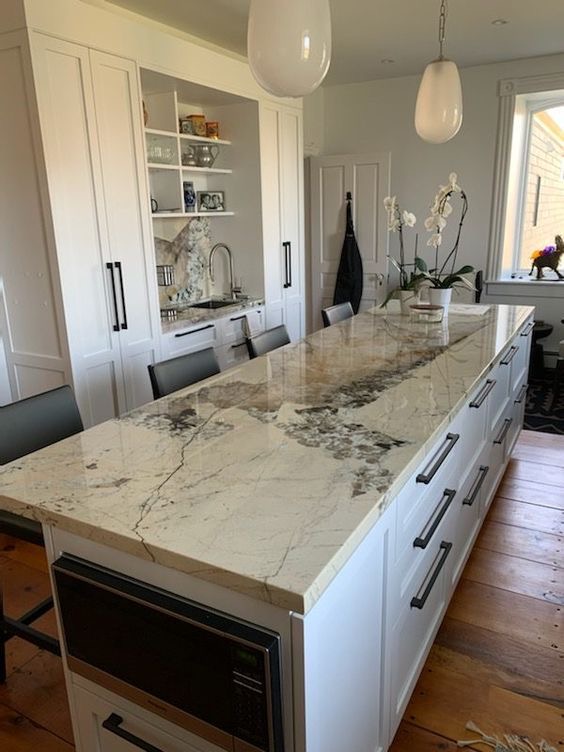
Then there was Patagonia, my original love. I was especially drawn to slabs with more light than dark, with beautiful movement and a mix of colors that would complement our walnut cabinetry. We also discovered Mona Lisa granite, another gorgeous natural stone with dramatic patterns and a warmth that worked beautifully with our cabinet samples.
For a while, like the last year, I imagined using a statement stone on the island and something quieter on the perimeter countertops. I loved the idea of the island being almost like a piece of art. But as we continued looking, I started wondering whether the kitchen really needed another statement.
We already have beautiful walnut cabinetry, a stone fireplace in the adjoining great room, wood beams and lighting fixtures with plenty of personality. Maybe the countertops didn’t need to compete with all of that. Maybe they needed to bring it all together.
Why we fell for black kitchen countertops
Somewhere along the way, we started looking at soapstone, and that changed everything.
There was something about it that felt completely different from the dramatic quartzites we’d been considering. It was quiet, but not boring. Dark, but not harsh. It had a softness and depth that I couldn’t stop thinking about. More than anything, it felt old in the very best way.
I could imagine it in a kitchen where generations of meals had been prepared, where people gathered around the island with a glass of wine, where flour ended up on the countertops and nobody was particularly concerned about it. That’s the kind of kitchen I want.
We started exploring the possibility of using that soapstone look throughout the kitchen, including the island, rather than introducing a contrasting statement stone. And suddenly, the whole design made more sense.
I shared a rendering of our kitchen with all-black countertops on Instagram, wondering whether other people would see what we were seeing. The response was wonderful, with so many people commenting on the warmth of the walnut against the dark stone and asking about the cabinets and countertops.
It was encouraging, but more importantly, it confirmed something we’d already begun to feel. We didn’t need the kitchen to be more dramatic. We loved it exactly because it wasn’t.
Finding honed Black Mist granite
As much as we loved the look of soapstone, we also wanted to explore other natural stones that might give us a similar feeling with different maintenance considerations. That’s when honed Black Mist granite entered the picture.
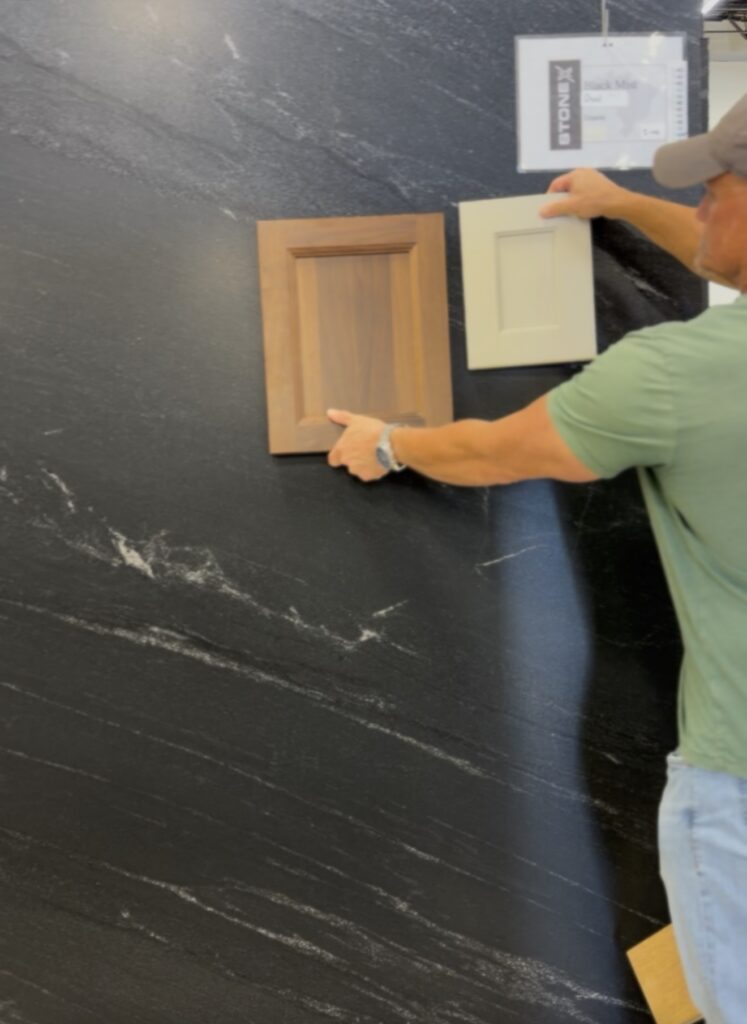
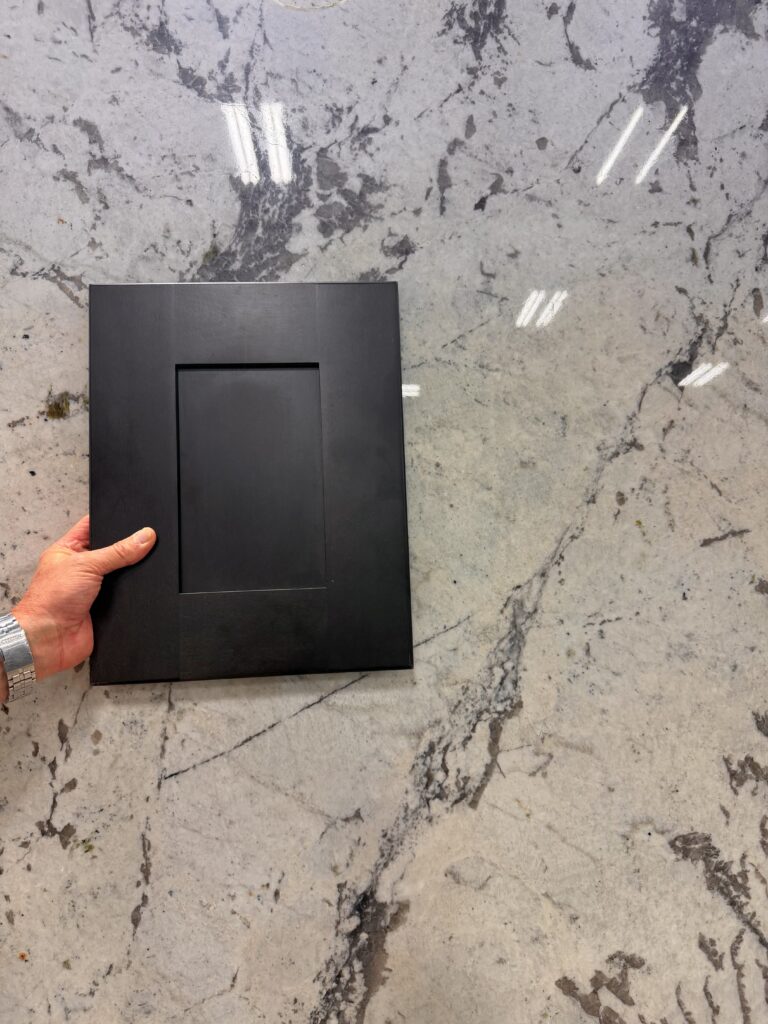
Black Mist has a deep, muted black color with subtle natural movement, and the honed finish gives it a soft, matte appearance rather than the polished shine many people associate with granite. It has the moody, almost soapstone-like character we were looking for, and it works beautifully with our walnut cabinet doors. We brought those samples with us while shopping, which I cannot recommend strongly enough. Seeing the actual materials together, in person, is so much more useful than trying to imagine how everything will look based on separate photographs.
We visited several stone suppliers, including StoneX in West Allis, Wisconsin, where we had a particularly wonderful experience. Being able to see full slabs, compare different materials and take our time with the selections helped us narrow down what we loved.
And we kept coming back to Black Mist.
The more I looked at it, the more I appreciated what it wasn’t doing. It wasn’t demanding attention or trying to be the most exciting material in the room. It was simply beautiful, with enough character to stand on its own and enough restraint to let everything around it shine. I think that’s what finally won me over.
Honed vs. Polished Granite: Why We Prefer the Matte Finish
The finish was just as important to us as the stone itself. Polished granite can be beautiful, but for our kitchen, we wanted something softer and less reflective. The honed finish gives Black Mist a more understated appearance, allowing the natural movement in the stone to show without the high shine.
There are practical considerations, of course. Honed dark countertops can show fingerprints, oils, water spots and other evidence of everyday life, depending on the stone and how it’s finished and maintained. And although granite is generally a durable material, that doesn’t mean it’s completely maintenance-free. We’re going into this knowing that no natural stone is perfect, and that some of the characteristics we love may require a little extra attention.
But we cook. A lot. Our kitchen is going to be used, and while I certainly want it to be beautiful, I don’t want a kitchen that feels too precious to live in. The goal has never been perfection. It’s been choosing materials that will look good, feel good and age gracefully alongside us.
Is Black Mist Granite a Good Alternative to Soapstone?
One of the reasons we were drawn to Black Mist granite is that it gives us so much of what we love about soapstone: that deep, muted color, subtle movement and wonderfully understated appearance. But they’re different materials, with different characteristics and maintenance requirements. Soapstone develops a patina over time and is softer than granite, while granite generally offers greater scratch resistance. Neither is completely carefree, and we know that honed black granite can show fingerprints and oils. For us, the decision came down to finding the combination of appearance, durability and everyday practicality that felt right for our kitchen.
And then the budget entered the conversation
Of course, this wouldn’t be a custom home build without a little budget drama. After spending weeks looking at stone, comparing options and finally feeling confident about the direction, we received our countertop pricing. We were approximately $12,000 over budget.
Ouch.
The interesting part is that the Black Mist granite in the kitchen wasn’t what pushed us over. It was the Mykonos quartzite we’d been considering for the bathrooms, a beautiful lighter stone that we hoped would bring a different feeling to those spaces.
We’d also been planning to use Mona Lisa granite in the pantry and laundry room, giving those smaller areas some of the dramatic natural stone we’d originally envisioned for the kitchen.
Individually, we loved the selections. Collectively, they were becoming a very expensive proposition.
So we went back to the drawing board, not to abandon the materials we loved, but to figure out whether we could use them more intelligently. And that’s where things stand today.
Making three slabs of Black Mist granite work
Our kitchen requires three slabs of Black Mist granite, but the actual layout and how much material will be left over are still being evaluated by our fabricator.
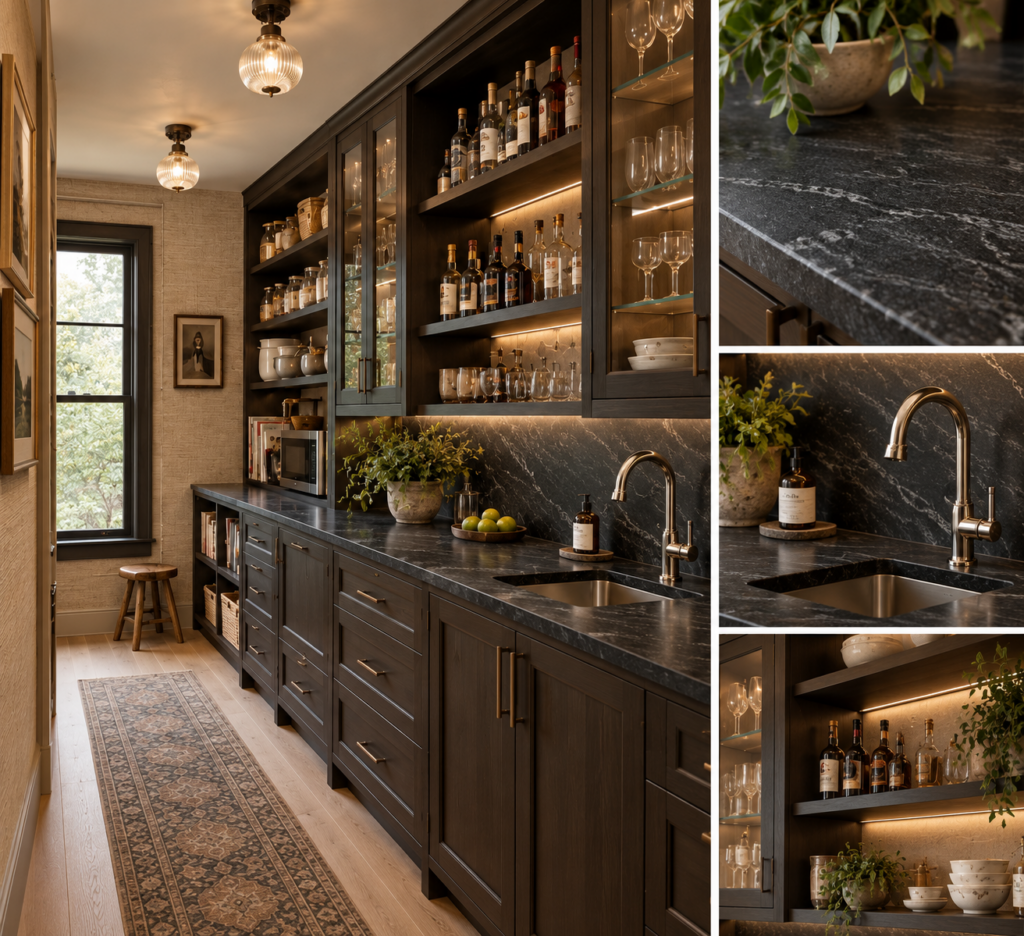
Rather than purchase additional stone for the pantry, we’re exploring whether we can use the Black Mist already included in those three slabs for both spaces.
The pantry has become one of my favorite little rooms in the house, with its cabinetry, open shelving, bar area and plans for some beautiful texture on the walls. Using the same dark stone as the kitchen could give it a wonderfully intimate, almost jewel-box feeling.
And because the pantry is connected to the kitchen, repeating the material might actually make the whole design feel more cohesive.
We may even be able to use Black Mist for a full-height backsplash behind the pantry countertops, which I think would be gorgeous. But that’s a wish-list item, not a requirement. If the material isn’t there, we’ll leave the backsplash unfinished for now and consider adding tile later. The important thing is that we’re not buying a fourth slab of Black Mist.
If our fabricator can make the kitchen and pantry work with the three slabs already needed, we’ll be able to eliminate the Mykonos quartzite purchase and move the Mona Lisa granite into the bathrooms instead.
We’ve also found a beautiful Cristallo remnant for the powder room, which would give us one small place to indulge in a more luminous, dramatic stone without committing to an entire slab. Fingers crossed as we wait to see if the people who have been holding this for months are willing to let it go.
It’s a bit of a puzzle, and one we’re still working through. The feasibility and actual savings depend on the slab dimensions, the cuts and what our fabricator can accomplish. Nothing has been purchased yet, and while we’re hopeful this plan will work, we’re not calling anything final until we have those answers.
What choosing natural stone has taught us
One of the things I love most about natural stone is that no two pieces are exactly alike. Every slab has its own movement, color variations, veining and little imperfections, all created long before any of us decided to put it in a kitchen.
There’s something pretty wonderful about bringing a piece of the earth into a home and allowing its natural beauty to be part of the design.
But this process has also reminded me that beautiful design isn’t always about choosing the most extraordinary material in every room. Sometimes it’s about knowing when to let something be quiet.
I started this process convinced that our kitchen needed a dramatic stone island, something that would immediately catch your eye when you walked into the room. And I still love those spectacular slabs of Patagonia and Mona Lisa. I’m sure I always will.
But when I look at our kitchen rendering now, with the walnut cabinets, the dark countertops and the warmth of all those natural materials coming together, I don’t feel like anything is missing. It feels like us. And that’s really what we’ve been trying to accomplish throughout this entire build. Not a show house. Not a collection of whatever happens to be popular in 2026. Just a warm, interesting, welcoming home that reflects the things we love and the way we want to live.
We’re not quite at the finish line with the countertops. We still need our fabricator to tell us whether our three-slab plan will work, and there may be another adjustment or two before the final order is placed.
But unless something unexpected happens, Black Mist granite will be the heart of our kitchen, Mona Lisa will find a home elsewhere in the house, and perhaps we’ll even get lucky with that Cristallo remnant.
For a decision that started with a completely different vision, I think we’ve landed somewhere pretty wonderful.
Now we just need the math to cooperate.
Have you used honed black granite or soapstone in your kitchen? I’d love to hear how it’s held up over time, especially from those of you who really cook in your kitchens.
We’re documenting the process of building Five Trails, our modern heritage home on five wooded acres in southeastern Wisconsin. Follow along on Instagram @fivetrailshome for the design decisions, construction updates and occasional budget surprises along the way.